
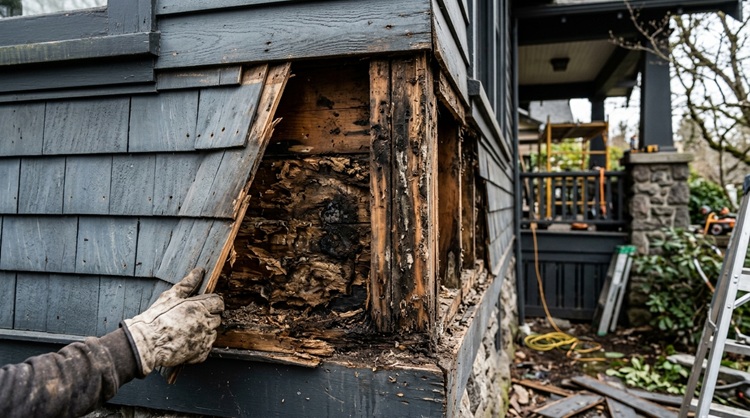

Replacing the exterior cladding on an older house can feel straightforward on paper. Remove the old material, address anything underneath, install new siding, and enjoy a cleaner look and better protection. In reality, siding replacement on older homes often turns into a “while we’re in there” project, not because contractors are trying to upsell, but because decades of hidden conditions get revealed the moment the first course comes off.
If you are planning an exterior update, the smartest thing you can do is understand the most common surprises ahead of time. That way you can set a realistic budget, avoid change-order shock, and make better decisions when the walls are opened up.
Below are the big issues that tend to appear on older homes, why they matter, and how they affect scope.
Table of Contents
1) You Might Not Be Removing One Layer of Siding
Many older homes have been re-sided at least once, sometimes multiple times. It is common to find vinyl installed over old wood clapboard, or aluminum installed over an even older layer. Each additional layer changes labor time, disposal needs, and the way details must be handled at windows, doors, corners, and trim.
Why it affects budget:
- More demo time and heavier debris.
- More surprises around trim depth and window casings.
- Additional prep work to create a flat substrate for the new system.
What to ask before the job starts:
- How many layers do you expect to remove?
- If you discover multiple layers, will you remove them all or leave a stable layer in place?
- How will you handle transitions at windows and doors if trim depth changes?
There is no universal right answer. Sometimes removing everything is best. Sometimes a sound layer can remain, but it requires careful detailing.
2) Hidden Rot Is Common, Especially Around Openings and Rooflines
Older homes often have areas where water has been getting in for years without being visible inside. The worst zones are predictable:
- Around windows and doors
- At corners
- At roof-to-wall intersections
- Behind gutters or downspouts
- Under improperly installed flashing
- Near decks, porches, or any attachment points
Once siding comes off, you may find soft sheathing, damaged framing, or crumbling trim.
Why it affects budget:
- Rot repair is not “optional” if you want the new siding to last.
- Repairs can expand quickly. A small window leak can turn into a large section of sheathing replacement.
Smart approach: Plan for a contingency line item. Even well-maintained older homes can hide localized decay.
3) Your Wall May Not Have Modern Weather-Resistive Barrier (WRB) or It May Be Failing
Many older houses were built before today’s expectations for continuous WRB and integrated flashing. Some have tar paper in rough shape. Others have none at all. Some have patchy layers added over time.
Why it affects budget and scope:
- A modern siding system performs best when installed over a continuous WRB with properly taped seams and integrated flashing at openings.
- Adding WRB and detailing correctly takes time and materials, but it reduces the chance of moisture intrusion.
Key concept:
Siding is not waterproof. It is a shedding surface. The WRB and flashing system behind it is what manages water that gets past the siding.
If your contractor treats WRB as optional or “extra,” ask more questions. On an older home, upgrading the water management layer is often one of the best investments you can make.
4) Flashing Details Are Often Missing or Incorrect
When older siding is removed, it is common to discover little to no flashing at critical transitions, or flashing installed in a way that directs water behind the wall.
Problem areas include:
- Head flashing above windows and doors
- Kick-out flashing where a roof meets a wall
- Flashing above and behind decorative trim
- Deck ledger board areas
- Penetrations like hose bibs, vents, and electrical meters
Why it affects budget: Proper flashing is detailed work. It takes time. But skipping it is how you get call-backs, stains, and sheathing rot.
What to listen for in a scope of work:
- “Integrated flashing” at windows and doors
- “Kick-out flashing” at roof-to-wall intersections
- “Penetration flashing” or “gaskets” for exterior fixtures
- A plan for water management, not just aesthetics
5) Insulation and Air Sealing May Be Uneven or Nonexistent
Older homes vary widely. Some have minimal insulation. Some have been retrofitted poorly. Some have air leaks around rim joists, window frames, and top plates that make rooms uncomfortable and increase energy use.
A siding project can be a rare chance to improve the envelope from the exterior, especially if you are adding foam board or another continuous insulation layer.
Why it affects scope and budget:
- Adding continuous insulation changes trim depth and requires more detailed finishing at openings.
- It can improve comfort and reduce drafts, but it needs to be planned so the system remains properly flashed and ventilated where required.
Practical point:
If the goal is comfort and efficiency, do not assume new siding alone solves it. Air sealing, insulation strategy, and detailing do the heavy lifting.